Legislative Updates
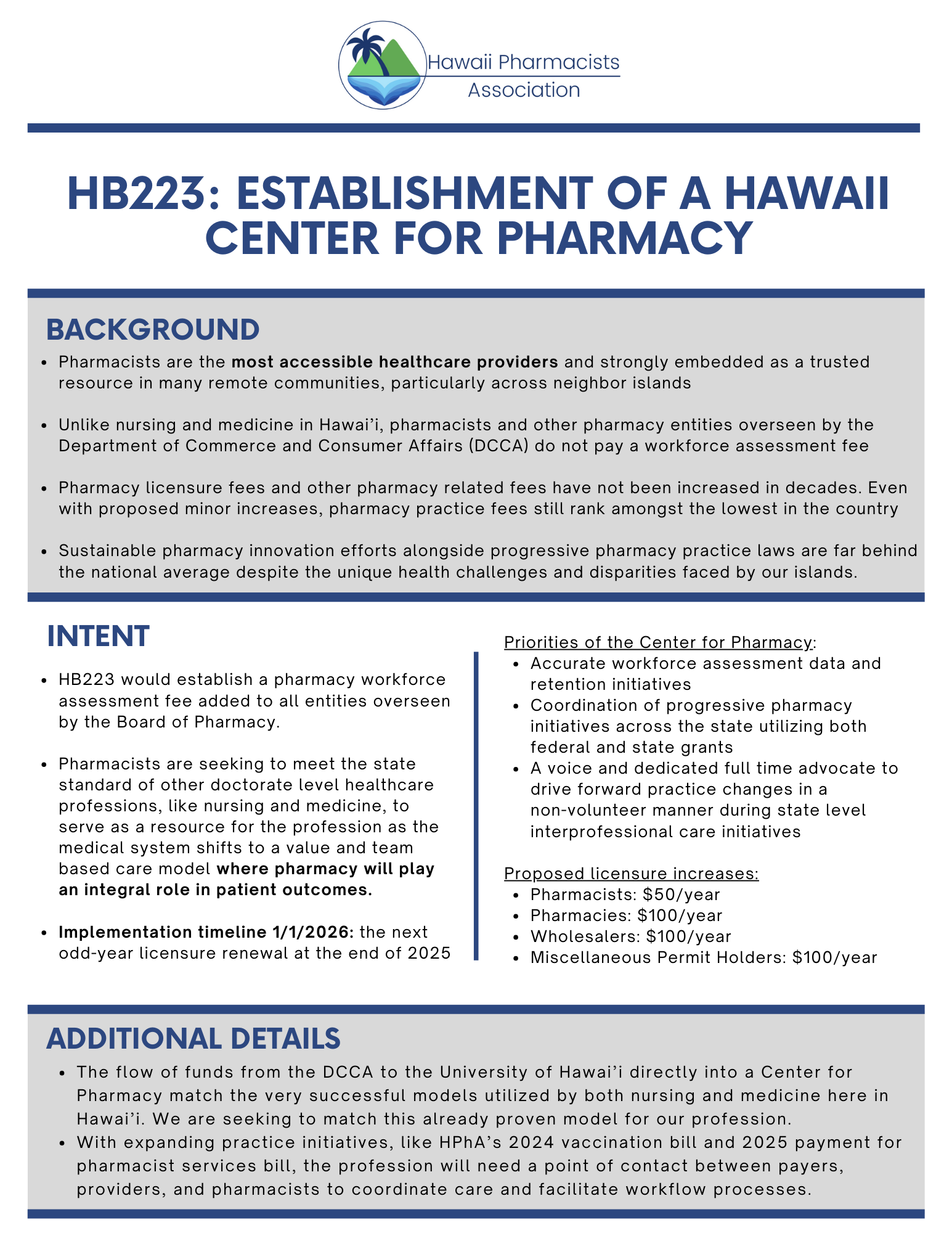
Center for Pharmacy (HB 223) - click here to follow the status (last updated 12/26/25).
Historic State Legislation Topics:
| Measure |
Description |
Latest Update |
| 2025 Legislative Session |
| HB72 |
Beginning 1/1/2026, requires pharmacy technicians to be registered with and obtain a certificate of registration issued by the Board of Pharmacy. Imposes a duty on pharmacists-in-charge to report violations by registered pharmacy technicians to the Board of Pharmacy. Specifies that supervising registered pharmacists are responsible for the actions of registered pharmacy technicians and pharmacy interns. (CD1 PDF) |
Signed into law on May 27, 2025. See the following statutes: HRS 461-1; 461-4.5; 461-5; 461-7; 461-8; 461-11.4; and 461-21. |
| HB223 |
Establishes the Daniel K. Inouye College of Pharmacy Special Fund to support pharmacist workforce assessment and planning efforts. Establishes the pharmacist workforce assessment fee. Appropriates funds. Effective 7/1/3000. (HD1 PDF) - Previously HB2113 |
Passed only two of the three required readings in the House. Will be reintroduced in the 2026 session. |
| SB1245 |
Beginning 7/1/2026, mandates reimbursement for services provided by participating registered pharmacists practicing within their scope of practice by private and public health plans in the State and requires the health plans to recognize pharmacists licensed in the State as participating providers. (HD2 PDF) |
Signed into law June 25, 2025. See the following statutes: HRS 431-10A; 432-1; 432D; and 346-59.1. |
| 2024 Legislative Session |
| HB2113 |
Establishes the Daniel K. Inouye College of Pharmacy Special Fund to support pharmacist workforce assessment and planning efforts. Establishes the pharmacist workforce assessment fee. Appropriates funds. Effective 7/1/3000. (HD1 PDF). |
Passed all required readings in the House and only first reading in the Senate. Will be reintroduced in the 2025 session. |
|
HB2553
|
Authorizes pharmacists to administer vaccines to persons three years of age or older. Authorizes pharmacy interns and pharmacy technicians under the direct supervision of a pharmacist to administer vaccinations to persons three years of age or older, if certain requirements are met. Authorizes pharmacists to order vaccines for administration to persons three years of age or older. Effective 1/1/2025. (Bill PDF) |
Signed into law on June 27, 2024. See the following statutes: HRS 461-1; 461-8; and 462-11.4. |
2023 Legislative Session
Historic National Legislation Topics:
|
Topic
|
Brief Description
|
Last Updated |
|
Supreme Court Issues a Stay to Allow for Continued Access to Mifepristone
|
The Supreme Court of the United States issued a stay on April 14, 2023, in Food and Drug Administration et. al., Applicants vs. Alliance for Hippocratic Medicine, et.al. This ruling protects the access to a widely used abortion drug, mifepristone. This decision came as a result of an emergency request by the Department of Justice to block a lower court ruling, limiting access to this medication, even in states where abortion remains legal.
|
4/14/2023 |
|
Supreme Court Rules in Favor of Pharmacists, Patients
Decision in Rutledge v. PCMA Validates State Efforts to Rein in PBMs
|
The Supreme Court of the United States issued on December 10, 2020, its landmark decision in Rutledge v. Pharmaceutical Care Management Association (PCMA), ruling in favor of an Arkansas law to prevent abusive PBM payment practices.
The unanimous (8 to 0) decision ruled in favor of the interests of patients and community pharmacies, who have been fighting for years to regulate pharmacy benefit managers (PBMs), the controversial middlemen that manage prescription drug benefits for health insurers, Medicare Part D drug plans, and large employers. With this ruling, states will have greater authority to protect their local businesses and their patients from PBM overreach.
The Arkansas law upheld by the Supreme court prohibits PBMs from reimbursing local pharmacies at a lower rate than what the pharmacies pay to fill prescriptions. PBMs often profit by reimbursing pharmacies at less than a pharmacy’s cost to acquire a drug. This is just one of the many ways the PBM system puts pharmacies and patients at a disadvantage.
|
12/10/2020 |
Tutorials:
|